Battle of Sekigahara
The Battle of Sekigahara (Shinjitai: 関ヶ原の戦い; Kyūjitai: 關ヶ原の戰い Sekigahara no Tatakai) was a decisive battle on October 21, 1600 (Keichō 5, 15th day of the 9th month) that preceded the establishment of the Tokugawa shogunate.
Tokugawa Ieyasu took three more years to consolidate his position of power over the Toyotomi clan and the daimyōs, but Sekigahara is widely considered to be the unofficial beginning of the Tokugawa bakufu, the last shogunate to control Japan.
Even though Toyotomi Hideyoshi unified Japan and consolidated his power following the Siege of Odawara in 1590, his failures in his invasions of Korea significantly weakened the Toyotomi clan's power as well as the support of the loyalists and bureaucrats that continued to serve and support the Toyotomi clan after Hideyoshi's death during the second invasion.[4] Hideyoshi's and his brother Hidenaga's presence kept the two main factions of the time, which rallied behind Ishida Mitsunari and Tokugawa Ieyasu respectively, from anything more than quarrelling, but when both of them died, the conflicts were exacerbated and developed into open hostilities.[4][5] With no appointed shogun over the armies, this left a power vacuum in the Japanese government.
Most notably, Katō Kiyomasa and Fukushima Masanori were publicly critical of the bureaucrats, especially Ishida Mitsunari and Konishi Yukinaga. Tokugawa Ieyasu took advantage of this situation, and recruited them, redirecting the animosity to weaken the Toyotomi clan.[6]
Later, a supposed conspiracy to assassinate Ieyasu surfaced, and many Toyotomi loyalists, including Toshiie's son, Toshinaga, were accused of taking part and forced to submit to Ieyasu's authority.[6] However, Uesugi Kagekatsu, one of Hideyoshi's appointed regents, defied Ieyasu by building up his military. When Ieyasu officially condemned him and demanded that he come to Kyoto to explain himself before the Emperor, Kagekatsu's chief advisor, Naoe Kanetsugu responded with a counter-condemnation that mocked Ieyasu's abuses and violations of Hideyoshi's rules, and Ieyasu was infuriated.[7]
Afterwards, Ieyasu summoned the help of various supporters and led them northward to attack the Uesugi clan. Many of them were at that moment besieging Hasedō though. Ishida Mitsunari, grasping the opportunity created by the chaos, rose up in response and created an alliance to challenge Ieyasu's supporters.
 Ishida wanted to reinforce Mori at the impregnable Osaka Castle. This would let Mitsunari control the traditional capital city of Kyoto and challenge Tokugawa’s power. To this end, Mitsunari’s forces headed for Gifu Castle in order to use it as a staging area to move on Kyoto, since it was controlled by his ally Oda Hidenobu.[4]
Back in Edo, Ieyasu received news of the situation in the Kansai region and decided to deploy his forces. Tokugawa himself commanded 30,000 men and his subordinates led another 40,000 men. This made up the bulk of what would later be called the Eastern Army.[9] He had some former Toyotomi daimyōs engage with the Western Army, while he split his troops and marched west on the Tōkaidō towards Osaka.
Since Tokugawa and his army were departing from Edo, they could only take two roads, both of which converged on Gifu Castle. Tokugawa marched on Gifu while Ishida was delayed at Fushimi Castle. This fortress was a halfway point between Osaka and Kyoto and was controlled by Tokugawa’s ally Torii Mototada.[10] Ishida could not risk leaving a force that could attack his rear, so he marched on it. It took him ten days to capture Fushimi, and in that time Tokugawa had taken Gifu Castle. This forced Ishida Mitsunari to retreat southward in the rain.[4]
Tired from a day's march and their gunpowder wet from the rain, Ishida and his forces stopped at Sekigahara. "Ishida deployed his troops in a strong defensive position, flanked by two streams with high ground on the opposite banks."[attribution needed] His right flank was reinforced by daimyō Kobayakawa Hideaki on Mount Matsuo.[11]
On October 20, 1600, Tokugawa learned that Ishida had deployed his troops at Sekigahara in a defensive position. They had been following the Western Army, and benefited from considerably better weather. At dawn of the next day, Tokugawa's advanced guard stumbled into Ishida's army. Neither side saw each other due to the dense fog caused by the earlier rain. Both sides panicked and withdrew, but this resulted in both sides being aware of their adversary's presence.[11]
Ishida held his current defensive position and Tokugawa deployed his own forces. He sent his allies' forces in a line to the front, and held his own troops in reserve. Around 8:00am, wind blew away the fog, and both sides noticed their respective adversary's positions. Last-minute orders were issued and the battle began.[12]
Tokugawa's forces started the battle when Fukushima Masanori, the leader of the advanced guard, charged north from Tokugawa's left flank along the Fuji River against the Western Army's right centre. The ground was still muddy from the previous day's rain, so the conflict there devolved into something more primal. Tokugawa then ordered attacks from his right and his centre against the Western Army’s left in order to support Fukushima's attack.[11]
This left the Western Army's centre unscathed, so Ishida ordered this unit under the command of Shimazu Yoshihiro to reinforce his right flank. Shimazu refused as daimyōs of the day only listened to respected commanders, which Ishida was not.[11]
Recent scholarship by Professor Yoshiji Yamasaki of Toho University has indicated that the Mori faction had reached a secret agreement with the Tokugawa two weeks earlier, pledging neutrality at the decisive battle in exchange for a guarantee of territorial preservation, and was a strategic decision on Mori Terumoto's part that later backfired.
Fukushima's attack was slowly gaining ground, but this came at the cost of exposing their flank to attack from across the Fuji River by Ōtani Yoshitsugu, who took advantage of this opportunity. Just past Ōtani's forces were those of Kobayakawa Hideaki on Mount Matsuo.[11]
Kobayakawa was one of the daimyōs that had been courted by Tokugawa. Even though he had agreed to defect to Ieyasu's side, in the actual battle he was hesitant and remained neutral. As the battle grew more intense, Ieyasu finally ordered arquebuses to fire at Kobayakawa's position on Mount Matsuo to force Kobayakawa to make his choice. At that point Kobayakawa joined the battle as a member of the Eastern Army. His forces charged Ōtani's position, which did not end well for Kobayakawa. Ōtani's forces had dry gunpowder, so they opened fire on the turncoats, making the charge of 16,000 men mostly ineffective.[12] However, he was already engaging forces under the command of Tōdō Takatora, Kyōgoku Takatsugu, and Oda Yūraku when Kobayakawa charged. At this point, the buffer Ōtani established was outnumbered. Seeing this, Western Army generals Wakisaka Yasuharu, Ogawa Suketada, Akaza Naoyasu, and Kutsuki Mototsuna switched sides, turning the tide of battle.[13]
Ishida’s only remaining forces were on Mount Nangu. However, these forces were there for a reason. Kikkawa Hiroie was one of the commanders on the mountain. Kikkawa's troops formed the front lines of the Mōri army, which was commanded by his cousin Mōri Hidemoto. Earlier, when Hidemoto decided to attack the Tokugawa forces, Hiroie refused to comply, stating he was busy eating and asked to be left alone. This in turn prevented the Chōsokabe army, which deployed behind the Mōri clan, from attacking.[14] When Ishida arrived, Kikkawa betrayed him as well. He kept the Mōri army at bay, and since Ishida had no more support, he was defeated.[12]
The Western Army disintegrated afterwards with the commanders scattering and fleeing. Some, like Ukita Hideie managed to escape, at least initially.[15] Many others did not. Shima Sakon was shot and fatally wounded by a round from an arquebus[16] and Ōtani Yoshitsugu committed suicide. Mitsunari, Yukinaga and Ekei were some of those who were captured and a few, like Mōri Terumoto and Shimazu Yoshihiro were able to return to their home provinces.[17] Mitsunari himself was later executed.[15]
At the same time, 15,000 Toyotomi troops were being held up by 500 troops under Hosokawa Yūsai at Tanabe Castle in present-day Maizuru, Kyoto Prefecture.[18] Some among the 15,000 troops respected Hosokawa so much they intentionally slowed their pace. Due to these incidents, a large number of troops from both sides failed to show up in time for the battle.[19] If either of these armies participated in the conflict, it could have ended quite differently.[20]
 Tokugawa Ieyasu redistributed the lands and fiefs of the participants, generally rewarding those who assisted him and displacing, punishing, or exiling those who fought against him. In doing so, he gained control of many former Toyotomi territories. Tokugawa himself also became quite wealthy.[21]
Following the public execution of Ishida Mitsunari, Konishi Yukinaga and Ankokuji Ekei, the influence and reputation of the Toyotomi clan and its remaining loyalists drastically decreased.[15]
At the time, the battle was considered only an internal conflict between Toyotomi vassals. However, after Ieyasu was named Shogun in 1603 by Emperor Go-Yōzei,[22][15] a position that had been left vacant since the fall of the Ashikaga shogunate 27 years earlier,[4] the battle was perceived as a more important event. In 1664, Hayashi Gahō, Tokugawa historian and rector of Yushima Seidō, summarised the consequences of the battle: "Evil-doers and bandits were vanquished and the entire realm submitted to Lord Ieyasu, praising the establishment of peace and extolling his martial virtue. That this glorious era that he founded may continue for ten thousands upon ten thousands of generations, coeval with heaven and earth."[23]
● = Daimyōs who defected
Tokugawa Ieyasu took three more years to consolidate his position of power over the Toyotomi clan and the daimyōs, but Sekigahara is widely considered to be the unofficial beginning of the Tokugawa bakufu, the last shogunate to control Japan.
| Battle of Sekigahara | |||||||||
|---|---|---|---|---|---|---|---|---|---|
| Part of the Sengoku period | |||||||||
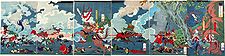
 Edo period screen depicting the battle. | |||||||||
| |||||||||
| Belligerents | |||||||||
| Western Army: Forces loyal to Toyotomi Hideyori, many clans from Western Japan | Eastern Army: Forces of Tokugawa Ieyasu, clans of Eastern Japan | ||||||||
| Commanders and leaders | |||||||||
Ishida Mitsunari  Mōri Terumoto Otani Yoshitsugu † Shimazu Yoshihiro Konishi Yukinaga Ukita Hideie Toda Shigemasa † Toda Katsushige † Gamo Yorisato † Natsuka Masaie † Shima Sakon † Shimazu Toyohisa † | Tokugawa Ieyasu Ii NaomasaTemplate:Died from wounds Hosokawa Tadaoki Honda Tadakatsu Kuroda Nagamasa Matsudaira TadayoshiTemplate:Died from wounds | ||||||||
| Strength | |||||||||
| 120,000 initially,[1] 81,890 by the time of battle[2] | 75,000 initially,[1] 88,888 by the time of battle[2] | ||||||||
| Casualties and losses | |||||||||
| 5,000–32,000 dead ~23,000 defected | Unknown; but not excessive Ii Naomasa (wounded) Matsudaira Tadayoshi (wounded) | ||||||||
Background
Oda Nobunaga had slowly consolidated control over much of Japan and was in control of the shogun, Ashikaga Yoshiaki. Ashikaga tried to escape this predicament in 1573 by attacking Oda, but failed and was exiled, thus ending his shogunate. Nobunaga ruled unopposed until he was betrayed by his own retainer Akechi Mitsuhide in 1582. While under attack in Kyoto, Nobunaga committed suicide by seppuku (not proved). Toyotomi Hideyoshi quickly avenged his master Nobunaga and consolidated control over Japan. Hideyoshi had risen from humble roots to become the ruler of Japan. His father was an ashigaru (foot-soldier). The death of Hideyoshi created a power vacuum in Japan, which ultimately was resolved by the outcome at Sekigahara.[3][4]Even though Toyotomi Hideyoshi unified Japan and consolidated his power following the Siege of Odawara in 1590, his failures in his invasions of Korea significantly weakened the Toyotomi clan's power as well as the support of the loyalists and bureaucrats that continued to serve and support the Toyotomi clan after Hideyoshi's death during the second invasion.[4] Hideyoshi's and his brother Hidenaga's presence kept the two main factions of the time, which rallied behind Ishida Mitsunari and Tokugawa Ieyasu respectively, from anything more than quarrelling, but when both of them died, the conflicts were exacerbated and developed into open hostilities.[4][5] With no appointed shogun over the armies, this left a power vacuum in the Japanese government.
Most notably, Katō Kiyomasa and Fukushima Masanori were publicly critical of the bureaucrats, especially Ishida Mitsunari and Konishi Yukinaga. Tokugawa Ieyasu took advantage of this situation, and recruited them, redirecting the animosity to weaken the Toyotomi clan.[6]
Prelude
Tokugawa Ieyasu was unrivalled in terms of seniority, rank, reputation and overall influence within the Regency of the Toyotomi clan after the death of Regent Maeda Toshiie. Rumours started to spread stating that Ieyasu, at that point the only surviving ally of Oda Nobunaga, would take over Hideyoshi's legacy just as Nobunaga's was taken. This was especially evident amongst the loyalist bureaucrats, who suspected Ieyasu of agitating unrest amongst Toyotomi's former vassals.Later, a supposed conspiracy to assassinate Ieyasu surfaced, and many Toyotomi loyalists, including Toshiie's son, Toshinaga, were accused of taking part and forced to submit to Ieyasu's authority.[6] However, Uesugi Kagekatsu, one of Hideyoshi's appointed regents, defied Ieyasu by building up his military. When Ieyasu officially condemned him and demanded that he come to Kyoto to explain himself before the Emperor, Kagekatsu's chief advisor, Naoe Kanetsugu responded with a counter-condemnation that mocked Ieyasu's abuses and violations of Hideyoshi's rules, and Ieyasu was infuriated.[7]
Afterwards, Ieyasu summoned the help of various supporters and led them northward to attack the Uesugi clan. Many of them were at that moment besieging Hasedō though. Ishida Mitsunari, grasping the opportunity created by the chaos, rose up in response and created an alliance to challenge Ieyasu's supporters.
Troop deployment
Mitsunari, in his home Sawayama Castle, met with Ōtani Yoshitsugu, Mashita Nagamori, and Ankokuji Ekei. Here, they forged the alliance, and invited Mōri Terumoto, who actually did not take part in Sekigahara, to be its head. Thus formed what came to be referred to as the Western Army. Mori seized Osaka Castle for their base of operations, since most of Tokugawa’s forces had vacated the area to attack Uesugi.[8]
The battle

Japanese arquebus (Tanegashima) of the Edo era.
Back in Edo, Ieyasu received news of the situation in the Kansai region and decided to deploy his forces. Tokugawa himself commanded 30,000 men and his subordinates led another 40,000 men. This made up the bulk of what would later be called the Eastern Army.[9] He had some former Toyotomi daimyōs engage with the Western Army, while he split his troops and marched west on the Tōkaidō towards Osaka.
Since Tokugawa and his army were departing from Edo, they could only take two roads, both of which converged on Gifu Castle. Tokugawa marched on Gifu while Ishida was delayed at Fushimi Castle. This fortress was a halfway point between Osaka and Kyoto and was controlled by Tokugawa’s ally Torii Mototada.[10] Ishida could not risk leaving a force that could attack his rear, so he marched on it. It took him ten days to capture Fushimi, and in that time Tokugawa had taken Gifu Castle. This forced Ishida Mitsunari to retreat southward in the rain.[4]
Tired from a day's march and their gunpowder wet from the rain, Ishida and his forces stopped at Sekigahara. "Ishida deployed his troops in a strong defensive position, flanked by two streams with high ground on the opposite banks."[attribution needed] His right flank was reinforced by daimyō Kobayakawa Hideaki on Mount Matsuo.[11]
On October 20, 1600, Tokugawa learned that Ishida had deployed his troops at Sekigahara in a defensive position. They had been following the Western Army, and benefited from considerably better weather. At dawn of the next day, Tokugawa's advanced guard stumbled into Ishida's army. Neither side saw each other due to the dense fog caused by the earlier rain. Both sides panicked and withdrew, but this resulted in both sides being aware of their adversary's presence.[11]
Ishida held his current defensive position and Tokugawa deployed his own forces. He sent his allies' forces in a line to the front, and held his own troops in reserve. Around 8:00am, wind blew away the fog, and both sides noticed their respective adversary's positions. Last-minute orders were issued and the battle began.[12]
Battle
Initially, Ieyasu's eastern army had 75,000 men, while Mitsunari's western army numbered 120,000.[1] Tokugawa had also sneaked in a supply of arquebuses.[11] Knowing that Ieyasu was heading towards Osaka, Mitsunari decided to abandon his positions and marched to Sekigahara. Even though the Western forces had tremendous tactical advantages, Ieyasu had already been in contact with many daimyō in the Western Army for months, promising them land and leniency after the battle should they switch sides.[11]Tokugawa's forces started the battle when Fukushima Masanori, the leader of the advanced guard, charged north from Tokugawa's left flank along the Fuji River against the Western Army's right centre. The ground was still muddy from the previous day's rain, so the conflict there devolved into something more primal. Tokugawa then ordered attacks from his right and his centre against the Western Army’s left in order to support Fukushima's attack.[11]
This left the Western Army's centre unscathed, so Ishida ordered this unit under the command of Shimazu Yoshihiro to reinforce his right flank. Shimazu refused as daimyōs of the day only listened to respected commanders, which Ishida was not.[11]
Recent scholarship by Professor Yoshiji Yamasaki of Toho University has indicated that the Mori faction had reached a secret agreement with the Tokugawa two weeks earlier, pledging neutrality at the decisive battle in exchange for a guarantee of territorial preservation, and was a strategic decision on Mori Terumoto's part that later backfired.
Fukushima's attack was slowly gaining ground, but this came at the cost of exposing their flank to attack from across the Fuji River by Ōtani Yoshitsugu, who took advantage of this opportunity. Just past Ōtani's forces were those of Kobayakawa Hideaki on Mount Matsuo.[11]
Kobayakawa was one of the daimyōs that had been courted by Tokugawa. Even though he had agreed to defect to Ieyasu's side, in the actual battle he was hesitant and remained neutral. As the battle grew more intense, Ieyasu finally ordered arquebuses to fire at Kobayakawa's position on Mount Matsuo to force Kobayakawa to make his choice. At that point Kobayakawa joined the battle as a member of the Eastern Army. His forces charged Ōtani's position, which did not end well for Kobayakawa. Ōtani's forces had dry gunpowder, so they opened fire on the turncoats, making the charge of 16,000 men mostly ineffective.[12] However, he was already engaging forces under the command of Tōdō Takatora, Kyōgoku Takatsugu, and Oda Yūraku when Kobayakawa charged. At this point, the buffer Ōtani established was outnumbered. Seeing this, Western Army generals Wakisaka Yasuharu, Ogawa Suketada, Akaza Naoyasu, and Kutsuki Mototsuna switched sides, turning the tide of battle.[13]
Fall of the Western Army
Heavily outnumbered, Ōtani had no choice but to retreat. This left the Western Army's right flank wide open, so Fukushima and Kobayakawa began to roll it up. Thus Ishida's right flank was destroyed and his centre was being pushed back, so he retreated.[12]Ishida’s only remaining forces were on Mount Nangu. However, these forces were there for a reason. Kikkawa Hiroie was one of the commanders on the mountain. Kikkawa's troops formed the front lines of the Mōri army, which was commanded by his cousin Mōri Hidemoto. Earlier, when Hidemoto decided to attack the Tokugawa forces, Hiroie refused to comply, stating he was busy eating and asked to be left alone. This in turn prevented the Chōsokabe army, which deployed behind the Mōri clan, from attacking.[14] When Ishida arrived, Kikkawa betrayed him as well. He kept the Mōri army at bay, and since Ishida had no more support, he was defeated.[12]
The Western Army disintegrated afterwards with the commanders scattering and fleeing. Some, like Ukita Hideie managed to escape, at least initially.[15] Many others did not. Shima Sakon was shot and fatally wounded by a round from an arquebus[16] and Ōtani Yoshitsugu committed suicide. Mitsunari, Yukinaga and Ekei were some of those who were captured and a few, like Mōri Terumoto and Shimazu Yoshihiro were able to return to their home provinces.[17] Mitsunari himself was later executed.[15]
Late arrivals
Both sides had forces that did not arrive at Sekigahara in time to participate due to other battles. Ieyasu's son Hidetada led another group through Nakasendō. However, Hidetada's forces were bogged down as he attempted to besiege Sanada Masayuki's Ueda Castle against his father's direct orders. Even though the Tokugawa forces numbered some 38,000, an overwhelming advantage over the Sanada's mere 2,000, they were still unable to capture the strategist's well-defended position.[10]At the same time, 15,000 Toyotomi troops were being held up by 500 troops under Hosokawa Yūsai at Tanabe Castle in present-day Maizuru, Kyoto Prefecture.[18] Some among the 15,000 troops respected Hosokawa so much they intentionally slowed their pace. Due to these incidents, a large number of troops from both sides failed to show up in time for the battle.[19] If either of these armies participated in the conflict, it could have ended quite differently.[20]
Aftermath
Rise of the Tokugawa Shogunate

Present day Sekigahara battlefield memorials
Following the public execution of Ishida Mitsunari, Konishi Yukinaga and Ankokuji Ekei, the influence and reputation of the Toyotomi clan and its remaining loyalists drastically decreased.[15]
At the time, the battle was considered only an internal conflict between Toyotomi vassals. However, after Ieyasu was named Shogun in 1603 by Emperor Go-Yōzei,[22][15] a position that had been left vacant since the fall of the Ashikaga shogunate 27 years earlier,[4] the battle was perceived as a more important event. In 1664, Hayashi Gahō, Tokugawa historian and rector of Yushima Seidō, summarised the consequences of the battle: "Evil-doers and bandits were vanquished and the entire realm submitted to Lord Ieyasu, praising the establishment of peace and extolling his martial virtue. That this glorious era that he founded may continue for ten thousands upon ten thousands of generations, coeval with heaven and earth."[23]
Seeds of dissent from Sekigahara
While most clans were content with their new status, there were many clans, especially those on the western side, who became bitter about their displacement or what they saw as a dishonorable defeat or punishment. Three clans in particular did not take the aftermath of Sekigahara lightly:- The Mōri clan, headed by Mōri Terumoto, remained angry toward the Tokugawa shogunate for being displaced from their fief, Aki, and being relocated to the Chōshū Domain, even though the clan did not take part in the battle at all.[17]
- The Shimazu clan, headed by Shimazu Yoshihiro, blamed the defeat on its poor intelligence-gathering, and while they were not displaced from their home province of Satsuma, they did not become completely loyal to the Tokugawa shogunate either. Taking advantage of its large distance between Edo and the island of Kyūshū as well as its improved espionage, the Shimazu clan demonstrated that it was virtually an autonomous kingdom independent from the Tokugawa shogunate during its last days.
- The Chōsokabe clan, headed by Chōsokabe Morichika, was stripped of its title and domain of Tosa and sent into exile. Former Chōsokabe retainers never quite came to terms with the new ruling family, the Yamauchi clan, which made a distinction between its own retainers and former Chōsokabe retainers, giving them lesser status as well as discriminatory treatment. This class distinction continued even generations after the fall of the Chōsokabe clan.
Kokudaka of daimyōs
○ = Main daimyōs who participated in Battle of Sekigahara● = Daimyōs who defected
| Daimyō | Kokudaka (ten thousands) | Daimyō | Kokudaka (ten thousands) | ||
|---|---|---|---|---|---|
| Western Army |  Mōri Terumoto Mōri Terumoto | 120.5 | Eastern Army |  Tokugawa Ieyasu ○ Tokugawa Ieyasu ○ | 256.0 |
 Uesugi Kagekatsu Uesugi Kagekatsu | 120.0 |  Maeda Toshinaga Maeda Toshinaga | 84.0 | ||
 Satake Yoshinobu Satake Yoshinobu | 54.0 |  Date Masamune Date Masamune | 58.0 | ||
 Shimazu Yoshihiro○ Shimazu Yoshihiro○ | 73.0 |  Katō Kiyomasa Katō Kiyomasa | 20.0 | ||
 Ukita Hideie○ Ukita Hideie○ | 57.0 |  Fukushima Masanori ○ Fukushima Masanori ○ | 24.0 | ||
 Ishida Mitsunari ○ Ishida Mitsunari ○ | 19.4 |  Hosokawa Tadaoki ○ Hosokawa Tadaoki ○ | 18.0 | ||
| Konishi Yukinaga ○ | 20.0 |  Asano Yoshinaga ○ Asano Yoshinaga ○ | 16.0 | ||
| Mashita Nagamori | 20.0 |  Ikeda Terumasa ○ Ikeda Terumasa ○ | 15.2 | ||
 Ogawa Suketada ● Ogawa Suketada ● | 7.0 |  Kuroda Nagamasa ○ Kuroda Nagamasa ○ | 18.0 | ||
| Ōtani Yoshitsugu ○ | 5.0 |  Katō Yoshiaki ○ Katō Yoshiaki ○ | 10.0 | ||
 Wakisaka Yasuharu ● Wakisaka Yasuharu ● | 3.3 |  Tanaka Yoshimasa ○ Tanaka Yoshimasa ○ | 10.0 | ||
 Ankokuji Ekei ○ Ankokuji Ekei ○ | 6.0 |  Tōdō Takatora ○ Tōdō Takatora ○ | 11.0 | ||
| Kobayakawa Hideaki● | 37.0 |  Mogami Yoshiaki Mogami Yoshiaki | 24.0 | ||
 Oda Hidenobu Oda Hidenobu | 13.5 |  Yamauchi Kazutoyo ○ Yamauchi Kazutoyo ○ | 5.9 | ||
 Chōsokabe Morichika ○ Chōsokabe Morichika ○ | 22.0 |  Hachisuka Yoshishige Hachisuka Yoshishige | 17.7 | ||
 Kutsuki Mototsuna ● Kutsuki Mototsuna ● | 1.0 |  Honda Tadakatsu ○ Honda Tadakatsu ○ | 10.0 | ||
| Akaza Naoyasu ● | 2.0 | Terazawa Hirotaka ○ | 8.0 | ||
 Kikkawa Hiroie ● Kikkawa Hiroie ● | 14.2 |  Ikoma Kazumasa ○ Ikoma Kazumasa ○ | 15.0 | ||
 Natsuka Masaie ○ Natsuka Masaie ○ | 5.0 |  Ii Naomasa ○ Ii Naomasa ○ | 12.0 | ||
| Mōri Hidemoto ○ | 20.0 |  Matsudaira Tadayoshi ○ Matsudaira Tadayoshi ○ | 10.0 | ||
 Toda Katsushige ○ Toda Katsushige ○ | 1.0 |  Tsutsui Sadatsugu ○ Tsutsui Sadatsugu ○ | 20.0 | ||
 Sanada Masayuki Sanada Masayuki | 3.8 |  Kyōgoku Takatomo ○ Kyōgoku Takatomo ○ | 10.0 |
Miyamoto Musashi
Legend has it that the rōnin Miyamoto Musashi was present at the battle among Ukita Hideie's army and escaped the defeat of Hideie's forces unharmed. Musashi would have been around 16 years of age at the time. There is no hard evidence to prove if Musashi was present or not for the battle. According to one account, the Musashi yuko gamei, "Musashi's achievements stood out from the crowd, and were known by the soldiers in all camps."[24] Musashi is reticent on the matter, writing only that he had "participated in over six battles since my youth".[25]In popular culture
- The battle of Sekigahara is depicted at the beginning of the 1954 movie Samurai I, the first of Hiroshi Inagaki's Samurai Trilogy.
- The related political intrigues leading up to the battle was the historical foundation for James Clavell's 1975 novel, Shōgun, later televised in 1980.
- A fictionalized version of the battle is featured in the beginning sequence of the film Journey of Honor (1991), starring Sho Kosugi.
- Re-enacted in the 2008 BBC Docudrama series Heroes and Villains.
- This battle was figured in the manga and anime series Samurai Deeper Kyo.
- This battle was figured in the manga Vagabond
- This battle was featured as a campaign in Age of Empires III: The Asian Dynasties
- The battle features as a playable "Historical Battle" in the 2011 real-time strategy game Total War: Shogun 2 in the side of Ishida Mitsunari.
- The battle features heavily into the strategy video game Kessen.
- This battle is depicted in Sengoku Basara: The Last Party and Sengoku Basara: End of Judgement.
- The battle of Sekigahara is fictionalized in the Young Samurai series as the Battle of Nakasendo
- The low-complexity block wargame Sekigahara: Unification of Japan, by GMT Games is based on Tokugawa's campaign, featuring a card based combat system without using dice.
- The battle of Sekigahara is featured in the Samurai Warriors series.
- This battle is very accurately depicted in the NHK historical drama Ten Chi Jin
- This battle was figured in the manga and anime series "Drifters".
- This battle is featured as a mission in the 2017 video game Nioh.
- The movie Sekigahara from 2017 retells the battle.


Comments
Post a Comment